


Table of Contents
Quick answer: Monstera deliciosa grows best in bright, indirect light for about 6-12 hours per day. Place it near an east- or north-facing window, or several feet back from a south- or west-facing window. Avoid prolonged direct afternoon sun, which can scorch the leaves.
Getting monstera sunlight right is the difference between a plant that produces huge, split leaves and one that sulks and stretches. Most guides stop at “bright, indirect light,” which isn’t much help when you’re standing in your living room. This guide turns that phrase into window directions, distances, and a simple shadow test.

Monstera Sunlight at a Glance
| Question | Quick answer |
|---|---|
| Best light for Monstera | Bright, indirect light |
| Daily duration | About 6-12 hours |
| Direct sunlight? | Brief, gentle morning sun is usually fine; avoid hot midday and afternoon sun |
| Best window | East-facing; filtered south or west can also work |
| Low light? | It may survive, but growth slows and fenestrations reduce |
| Grow light? | Yes, a full-spectrum LED positioned correctly |
How Much Sunlight Does a Monstera Need?
In its native rainforest habitat, a Monstera climbs beneath a canopy and receives dappled, filtered light. Indoors, you’re recreating that. The monstera light requirements come down to three things:
- Bright, indirect light for most of the day
- Roughly 6-12 hours of usable light
- No harsh, concentrated sun hitting the leaves for extended periods
More light generally means faster growth, larger leaves, and more fenestrations (the splits and holes), but only when water, humidity, and nutrients keep up.
| Light condition | What it means | Effect on Monstera |
|---|---|---|
| Low light | Dim room, far from windows | Slow growth, smaller leaves, fewer splits |
| Medium indirect | Near a window, no harsh sun | Healthy but slower growth |
| Bright indirect | Bright room, filtered or reflected sun | Best growth and fenestration |
| Direct morning sun | Gentle sun before midday | Usually tolerated if introduced gradually |
| Hot afternoon sun | Unfiltered south/west exposure | Leaf burn, yellow patches, curling |
Can Monstera Get Direct Sunlight?
Yes, but with limits. Gentle early-morning sun is far safer than intense afternoon rays. A Monstera moved suddenly from indoors into full sun can burn, even though the species tolerates some direct light. Use sheer curtains, blinds, or extra distance from the glass to soften strong sun.
The shadow test: Hold your hand between the light source and a leaf. A sharp, dark shadow for hours means the light is likely too intense. A soft but clearly visible shadow means you’re in bright indirect territory.
Best Window Placement for Monstera Sunlight
| Window direction | Recommended placement | Notes |
|---|---|---|
| East-facing | Near the window | Often ideal: bright morning light, low scorch risk |
| North-facing | Close to the window | Works in bright climates; may be too dim in winter |
| South-facing | 3-6 feet back or behind a sheer curtain | Strong light; avoid unfiltered midday exposure |
| West-facing | Several feet back or filtered | Afternoon sun is intense, especially in summer |
Competing guides often contradict each other here because “south-facing” means different things in different hemispheres and climates. Treat these distances as starting points and let the shadow test and your plant’s leaves make the final call.
Signs Your Monstera Is Getting Too Little Light
| Symptom | What to do |
|---|---|
| Slow or no new growth | Move closer to a window or add a grow light |
| Small leaves | Increase light gradually |
| Few or no fenestrations | Improve light; be patient with young plants |
| Leggy stems | Move closer to the light source |
| Soil stays wet too long | Increase light and adjust watering |
| Pale, weak growth | Relocate or supplement with LED light |
Light isn’t the only factor in fenestration. Plant age, overall health, and genetics matter too, so a young Monstera may simply need time.
Signs Your Monstera Is Getting Too Much Sun
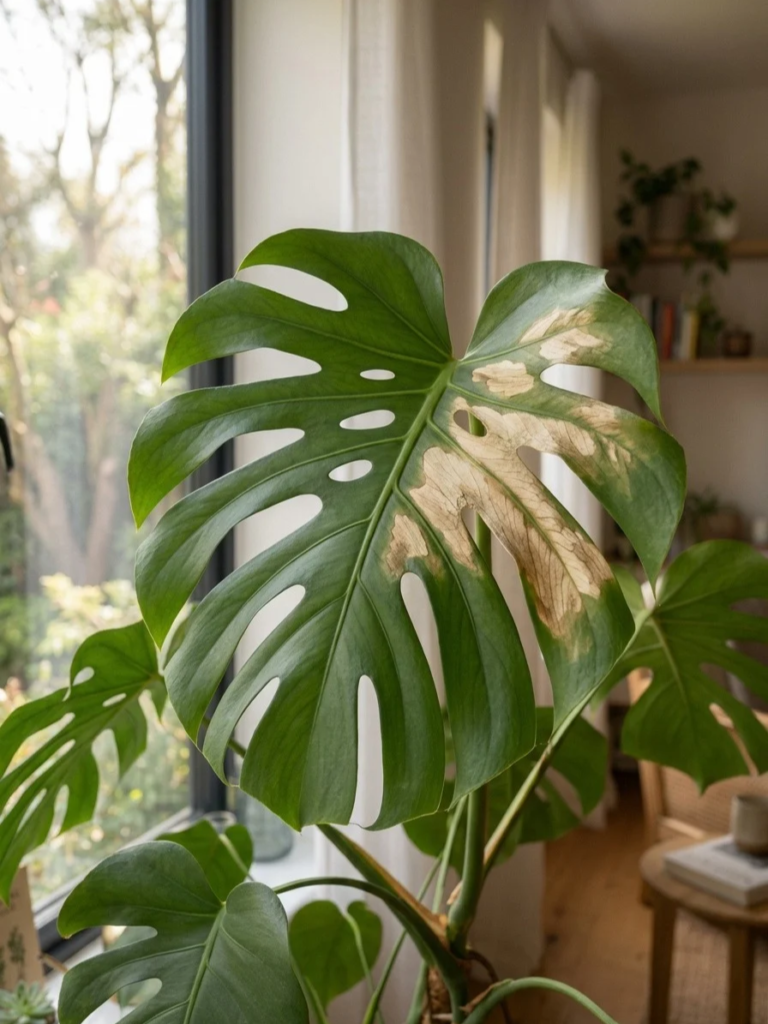
| Symptom | What it means | What to do |
|---|---|---|
| Yellow or bleached patches | Sun scorch | Move away from direct sun |
| Brown, crispy edges | Excess heat/light or dryness | Filter light, check watering |
| Curling leaves | Heat, light, or dryness stress | Reduce exposure; check humidity and soil |
| Faded leaf color | Overly intense light | Move to filtered light |
| Burn right after a move | Light shock | Acclimate gradually |
How to Use a Grow Light for Monstera
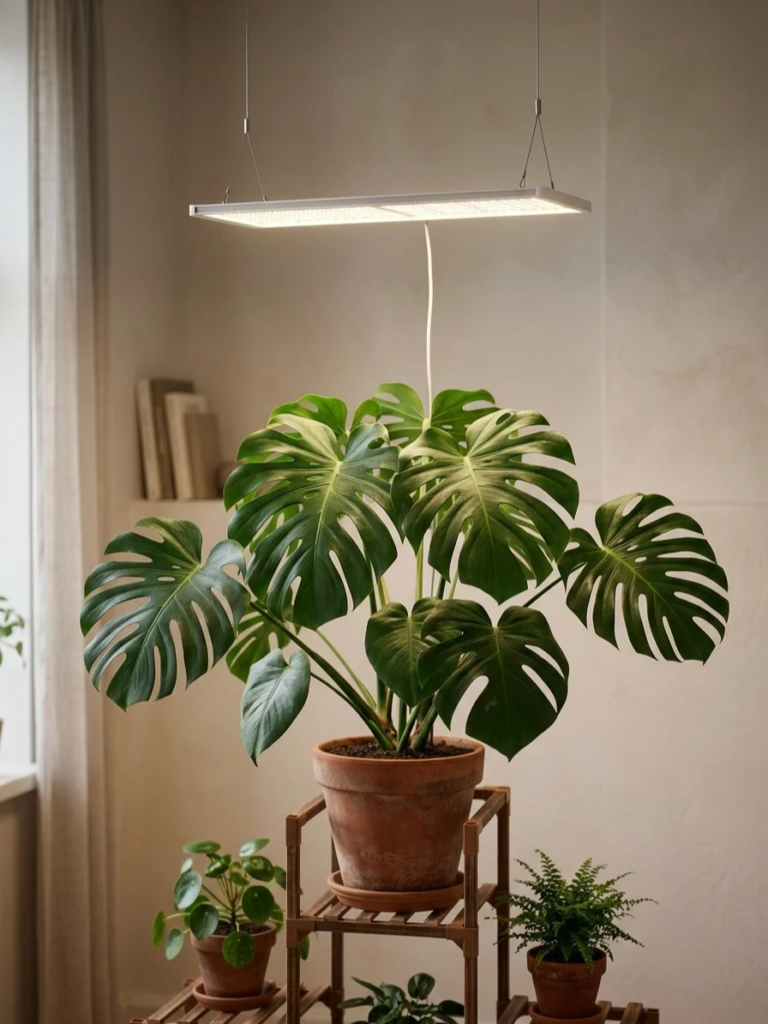
A grow light helps in dark apartments, north-facing rooms, and winter. Look for:
- A full-spectrum LED with adjustable intensity
- Coverage appropriate for your plant’s size
- Placement above the plant, following the manufacturer’s distance guidance
- 10-12 hours daily, never 24-hour light
Can a grow light burn a Monstera? Yes. Too much intensity or too little distance can cause bleached patches or brown edges. Start farther away, run it for shorter periods, and increase exposure gradually.
Monstera Sunlight in Summer vs. Winter
- Summer: The sun is stronger and days are longer. Protect your plant from hot afternoon rays with a sheer curtain or extra distance.
- Winter: Light is weaker and days are shorter. Move the plant closer to the window or add supplemental light.
After any seasonal move, watch the leaves for one to two weeks.
How to Acclimate a Monstera to Brighter Light
- Start in its current spot.
- Move it 1-2 feet closer to the brighter window every few days.
- Use a sheer curtain during the first week if the light is intense.
- Watch for curling, bleaching, or brown patches.
- If stress appears, move it back slightly and progress more slowly.
The full process takes about two to three weeks.
Monstera Sunlight FAQs
Do Monsteras need sunlight? Yes. They need bright, indirect light and don’t thrive in dark rooms.
Can a Monstera live in low light? It may survive, but growth is slow and leaves stay smaller with fewer splits.
Is morning sun good for Monstera? Gentle morning sun is usually beneficial, especially from an east-facing window.
Can a Monstera get sunburned? Yes. Hot, unfiltered direct sun can cause yellow, brown, or bleached patches.
How far should a Monstera be from a window? Near an east window, or about 3-6 feet back from a strong south or west window, depending on climate and season.
Do Monsteras need a grow light in winter? Often, yes, in darker homes or northern climates, especially if new growth slows.
Next Steps
Light affects everything else in your care routine. Pair this guide with our Monstera watering guide (low light means slower water use), plus our pages on humidity, fertilizing, repotting, and yellowing or curling leaves. If your plant isn’t splitting, read Why Is My Monstera Not Fenestrating?
- Monstera Care
- This Is How Much Light a Monstera Really Needs
- Monstera Care Guide 2025: The Science of Healthy Indoor Growth & Massive Fenestrations
What do you think of blogging? Did it benefit you?
There are no reviews yet. Be the first one to write one.