


Table of Contents
A snake plant care guide on light, placement, grow lights, and watering
Snake plant light requirements in short: start with about 6-8 hours of bright, indirect light a day. Snake plants (Dracaena trifasciata, formerly Sansevieria trifasciata) tolerate low light, but growth slows and variegated types may fade. Prolonged, intense direct sun can scorch leaves. In dim rooms, a full-spectrum LED grow light for 12-14 hours daily is a common starting point.
That covers the basics. The real question is the difference between a snake plant that survives and one that thrives. This guide shows what “bright, indirect” looks like in a real home and where to put your plant.

At a Glance: Snake Plant Light Requirement
| Light condition | Best use | Expected result |
|---|---|---|
| Bright, indirect | Best placement | Steady growth, strong color |
| Medium, indirect | Good long-term spot | Slower but healthy growth |
| Low, indirect | Tolerant varieties only | Survival or very slow growth |
| Direct afternoon sun | Avoid or filter | Scorch, bleaching, brown patches |
| No natural light | Needs a grow light | Not sustainable otherwise |
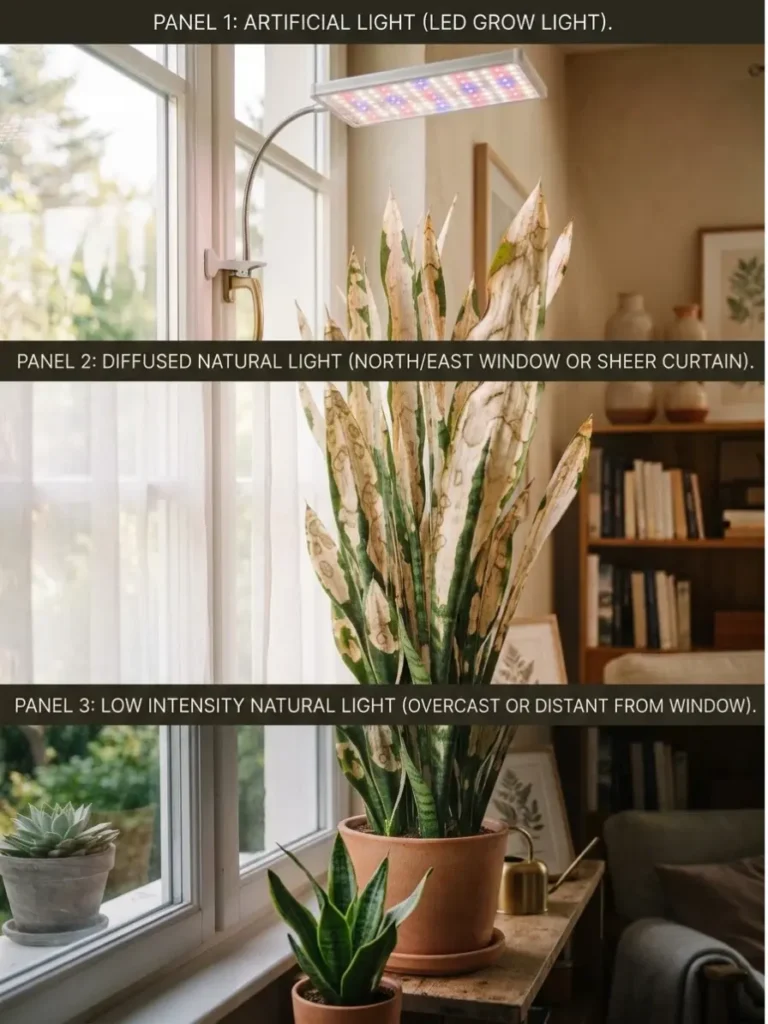
Snake plants are adaptable, but low-light tolerance does not mean every dim spot gives enough light for sustained growth. A simple test: bright, indirect light is bright enough to cast a soft shadow, with no sunbeams hitting the leaves. Iowa State University Extension’s houseplant guidance notes that snake plants tolerate a range of conditions and generally look best in moderate to bright light.
How Much Light Does a Snake Plant Need? A Practical Chart
| Light level | What it looks like | Snake plant outcome | Action |
|---|---|---|---|
| Bright, indirect | Bright room, no sunbeams on leaves | Best growth and color | Ideal |
| Medium, indirect | Noticeably bright, no direct sun | Healthy, slower growth | Fine long-term |
| Low, indirect | Dim, faint shadow possible | Slow growth, less variegation | Water less; consider an LED |
| Very low | Dark corner or hallway | Gradual decline | Move closer or add light |
| Direct sun | Sunbeams touch the leaves | Scorch, brown patches | Filter or move back |
These categories are practical descriptions, not precise measurements. If you use a light meter, record readings at leaf level and compare the same spot at different times of day.
Snake Plant Window Placement: A Direction-by-Direction Guide
Window direction helps you choose a spot, but it doesn’t decide light quality alone: climate, hemisphere, season, nearby buildings, curtains and window size all matter. Light intensity also drops sharply as you move away from the glass. The Mississippi State University Extension guide to indoor plants explains how distance, window exposure and obstructions affect indoor light.
- East-facing window (best default): Gentle morning sun is usually safe, so place the plant near the glass.
- North-facing window (best low-light window): It supports steady, slow growth. Keep the plant close to the glass. This is where the plant survives but may not fully thrive.
- South-facing window: Use a sheer curtain or set the plant several feet back to avoid harsh midday sun. Watch for seasonal changes, since summer sun is far stronger than winter sun.
- West-facing window: Hot afternoon sun is the risk here. Filter it with a curtain or move the plant back from the glass.
- Interior room or hallway: This only works with meaningful ambient light. Otherwise, add a grow light.
- Windowless room: Ordinary ceiling lighting isn’t enough. You need a grow light on a timer.
Natural Light: Hours, Seasons and Rotation
As a starting point, aim for about 6-8 hours of bright, indirect light daily, then judge by how the plant responds rather than by a fixed schedule. In winter, shorter days slow growth, so move the plant closer to a suitable window, keeping the leaves off cold glass. In summer, check whether stronger direct sun reaches the leaves. Rotate the pot occasionally if the plant leans, though rotation doesn’t make up for too little light. A light meter or phone app helps compare spots, but phone readings aren’t calibrated, so use them for comparison, not exact measurement.
Snake Plant Grow Light Setup
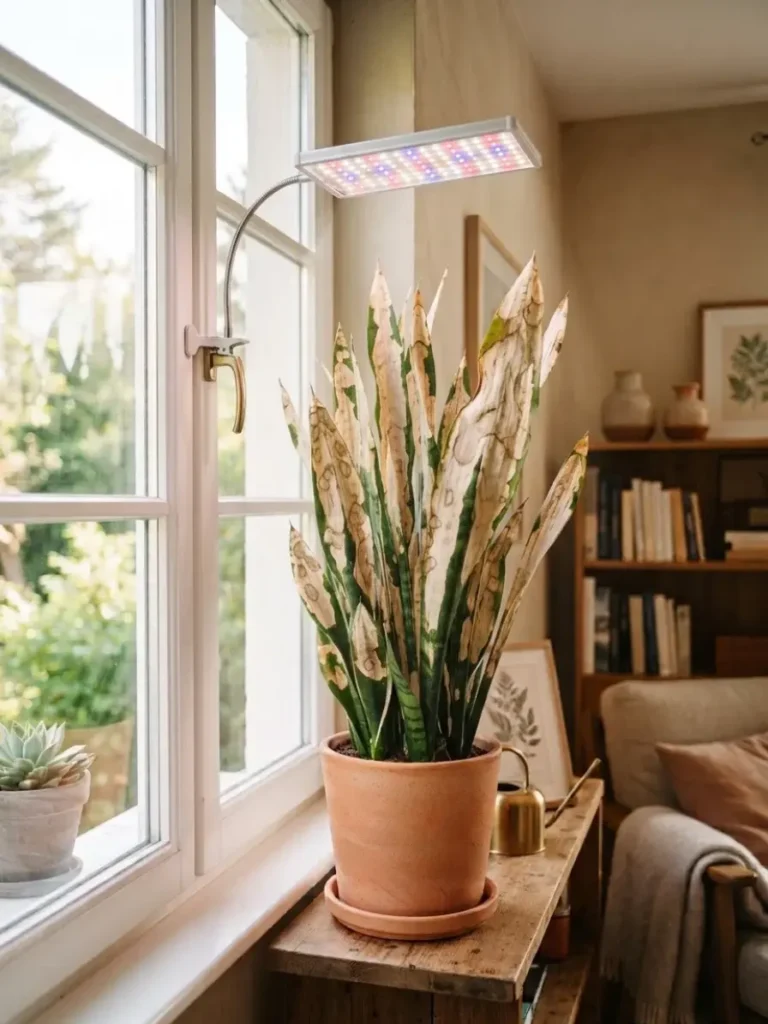
A grow light helps in north-facing rooms, dark apartments, offices, and during winter.
- Type: full-spectrum LED. Choose a fixture with clear manufacturer guidance on coverage, mounting distance and run time, since wattage alone doesn’t tell you how much usable light reaches the leaves.
- Duration: 12-14 hours daily is a common extension starting point for indoor plants under supplemental light, not a proven requirement for every snake plant or fixture. See Iowa State’s supplemental lighting guide. Use a timer, count daylight if the light supplements a window, and avoid going past about 16 total hours.
- Distance: start with the manufacturer’s guidance. Many household LEDs work at roughly 12-24 inches from the foliage, but it depends on output and beam spread. Change one variable at a time.
- Too much light: bleaching, washed-out color, crispy edges
- Too little light: slow growth, leaning, pale variegation, soil that stays wet too long
Light and Watering: The Overlooked Connection
Low light does more than slow growth, because it also changes how often you should water. A snake plant that survives dim light can still die from overwatering.
Searching for how often to water a snake plant usually gets you a calendar answer. A better rule is to water by soil dryness. Iowa State advises watering only after the soil has completely dried, and it names overwatering as a leading cause of decline.
- Soil dries more slowly in low light, so water less.
- Use a fast-draining succulent mix and a pot with drainage holes.
- Cut back further in winter.
Low light doesn’t automatically mean overwatering, and slow soil drying isn’t proof of a lighting problem: pot size, soil mix, temperature and airflow matter too. For a broader overview, see our Sansevieria and mother-in-law’s tongue care guide.
Too Much vs. Too Little Light: Diagnosis Table
| Symptom | Likely cause | Fix |
|---|---|---|
| Pale, bleached, yellow-brown patches | Too much direct sun | Move back or add a sheer curtain |
| Crispy brown edges | Sun stress, heat, low humidity | Filter light; check watering |
| Leaning or stretching | Insufficient light | Move closer or add a grow light |
| Faded variegation | Low light | Increase brightness gradually |
| No new growth for months | Low light, winter dormancy, or rootbound | Fix light first, then check roots |
| Yellow, soft lower leaves | Often overwatering, especially in low light | Check soil and roots; water less |
Don’t diagnose from one symptom alone. Check recent changes in light, watering, temperature and soil moisture before making big adjustments.
Snake Plant Light Requirements by Variety
| Variety | Low-light tolerance | Key note |
|---|---|---|
| Standard green Dracaena trifasciata | High | Most forgiving |
| ‘Laurentii’ | Moderate | Yellow margins may fade in dim spots |
| ‘Moonshine’ | Moderate | Silvery color can darken in low light |
| ‘Hahnii’ / Bird’s Nest | Moderate to high | Compact, good for shelves and desks |
| ‘Black Gold’ | Moderate | Color contrast benefits from brighter light |
| Whale fin (D. masoniana) | Moderate | Large leaves still need usable light |
All of these prefer bright, indirect light, and the variegated types are the most likely to fade in dim spots. Color changes aren’t always caused by light alone, since cultivar traits and plant health matter too, so judge by how your own plant responds.
Common Mistakes to Avoid
- Putting the plant in a dark corner because it’s labeled “low light”
- Assuming tolerance means it thrives anywhere
- Moving a nursery plant straight into harsh afternoon sun without acclimation
- Watering on a fixed schedule regardless of light
- Using a decorative pot without drainage
- Fertilizing a light-starved plant instead of improving its light
- Keeping the plant in a windowless room with no supplemental light
FAQ
Do snake plants need direct sunlight?
No. They prefer bright, indirect light. Some direct sun may be tolerated after gradual acclimation, but intense afternoon sun can scorch leaves.
Can snake plants grow in low light?
Yes, but growth is slower and variegated types may lose color.
How many hours of light does a snake plant need?
There’s no universal hourly requirement. A practical starting point is about 6-8 hours of bright, indirect light daily. Under grow lights, 12-14 hours is a common starting point, depending on fixture output and natural light.
Where should I put my snake plant?
Near an east-facing window is ideal. A north window works for lower light, and south or west windows need filtering.
Can a snake plant survive in a windowless room?
Only with a suitable grow light, because ordinary room lighting is usually insufficient.
Why is my snake plant not growing?
Common causes are low light, winter slowdown, overwatering, or a rootbound pot.
Can snake plants get too much light?
Yes. Intense direct sun can cause bleached patches, brown edges, and scorch.
Final Takeaway
Snake plants forgive a lot, but they grow best with bright, indirect light, a well-chosen window, and watering matched to how dry the soil is. Hours alone don’t determine light quality, so start by checking your plant’s current spot against the light chart, then adjust distance, filtering, or lighting as the seasons change.
Related reading: Sansevieria Care: The Truth About Mother-in-Law’s Tongue & How to Keep It Alive – How to Care for a Snake Plant: Complete Care Guide
What do you think of blogging? Did it benefit you?
There are no reviews yet. Be the first one to write one.