


Table of Contents
If you’ve ever stood over your ZZ plant with a watering can, second-guessing whether today’s the day, you’re not alone. ZZ plant watering is one of those deceptively simple tasks that new plant parents often overthink—and ironically, that overthinking leads to the most common mistake: overwatering.
Here’s the truth: your Zamioculcas zamiifolia (yes, that’s the fancy name) is built to survive drought, not daily attention. In fact, the secret to thriving ZZ plant care isn’t about what you do—it’s about what you don’t do.
TL;DR: How Often Should You Water a ZZ Plant?
A ZZ plant (Zamioculcas zamiifolia) should only be watered when the soil is 100% dry. This typically takes:
- 2–3 weeks in summer
- 4–6 weeks in winter
The Golden Rule: If you’re unsure, wait another week. It’s safer to underwater than overwater.
Understanding the Biology: The Rhizome Factor
Before we dive into watering schedules, let’s talk about what makes your zamioculcas plant so resilient. Unlike most houseplants that rely on constant soil moisture, ZZ plants grow from thick, underground structures called rhizomes—essentially potato-like tubers that act as the plant’s personal water reservoir.
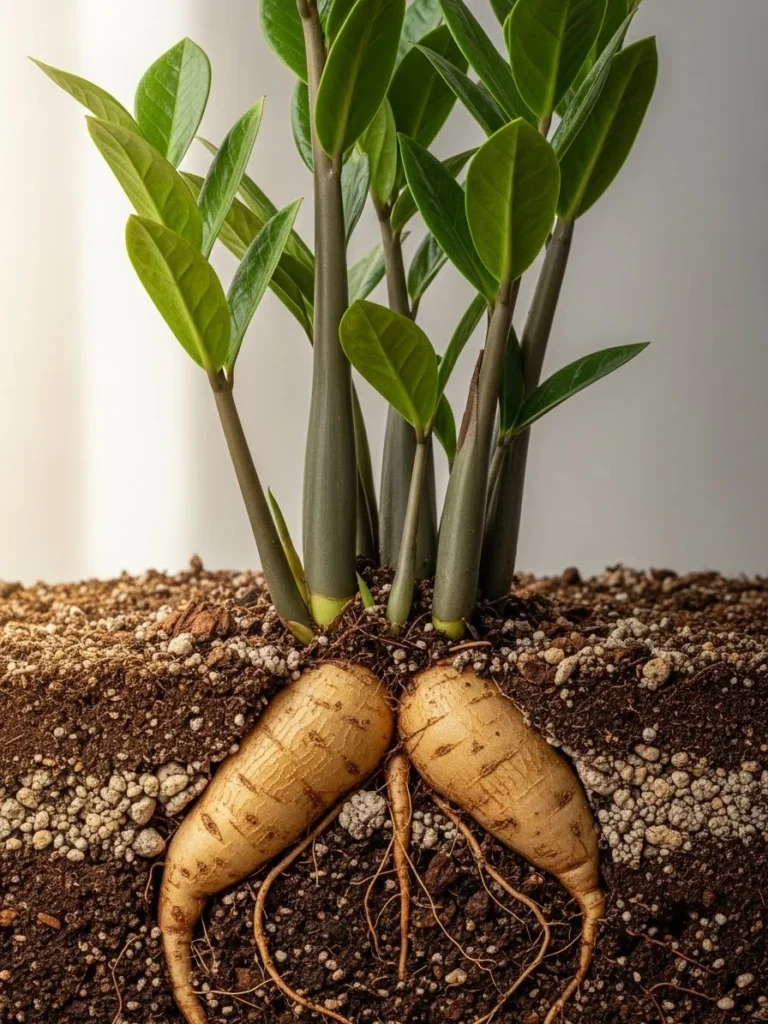
These rhizomes act as internal water tanks, meaning the plant hydrates itself even when the soil is dry.
Think of it this way: while a fern is like someone sipping water throughout the day, your ZZ plant is a camel storing reserves for the long haul. This evolutionary adaptation to the drought-prone regions of Eastern Africa means the plant is programmed to expect—and even prefer—periods of dryness.
When you water too frequently, those rhizomes can’t properly regulate moisture, leading to rot. It’s not that you’re loving your plant too much; you’re just speaking the wrong language.
The 3 Factors That Change Your Watering Schedule
Here’s where most generic plant care guides fall short. They give you a timeline—”water every two weeks”—without acknowledging that your environment isn’t universal. The truth about ZZ plant watering depends on three critical variables:
1. Light Levels
More light equals faster photosynthesis, which means more water consumption. A ZZ plant basking in bright indirect light near a south-facing window will need water more frequently than one tucked in a dim corner. In low light conditions, your plant essentially goes into slow-motion mode, barely sipping from its reserves.
2. Pot Material
Not all pots are created equal:
- Terra cotta pots are porous and breathable, allowing moisture to evaporate through the sides. Your soil will dry out faster—sometimes in 10–14 days.
- Plastic or glazed ceramic pots trap moisture inside, extending the time between waterings to potentially 4–6 weeks.
3. Soil Mix
Are you using a chunky aroid mix with perlite and orchid bark, or dense, moisture-retaining potting soil? The former drains quickly and requires more frequent watering, while the latter holds water longer. For optimal ZZ plant care, aim for a well-draining mix that dries completely between waterings.
Visual Diagnosis: Thirsty vs. Drowning
One of the most powerful skills you can develop is reading your plant’s signals. Here’s a side-by-side comparison to help you diagnose what your ZZ plant is actually telling you:
| Feature | Thirsty ZZ Plant | Overwatered ZZ Plant |
|---|---|---|
| Leaves | Wrinkled, slightly drooping | Yellowing, mushy, falling off |
| Stems | Shriveled vertical lines | Brown spots, soft at the base |
| Soil | Pulled away from pot edge | Smells musty or damp |
| Action | Water thoroughly immediately | Stop watering, check for root rot |
Pro tip: Gently squeeze a stem near the base. A healthy, hydrated ZZ plant feels firm and turgid. If it feels soft or squishy, you’ve got a problem—and it’s almost certainly overwatering.
Step-by-Step: Top Watering vs. Bottom Watering
Most people default to pouring water from the top, but there’s actually a superior method that professional growers use: bottom watering.
The Bottom Watering Method (Recommended)
Step 1: Place your potted ZZ plant in a basin, sink, or tray filled with 2–3 inches of room-temperature water.
Step 2: Wait 45–60 minutes until you see the topsoil become moist to the touch.
Step 3: Remove the pot and allow excess water to drain completely.
Why this works: Bottom watering encourages roots to grow downward, prevents fungus gnats (which thrive in damp topsoil), and ensures even moisture distribution throughout the root zone. It’s particularly effective for ZZ plant watering because it mimics natural rainfall soaking upward through soil layers.
Traditional Top Watering
If bottom watering isn’t practical, water from the top until you see drainage from the bottom holes. The key word here is drainage—you should always have drainage holes. Never let your plant sit in standing water.
FAQ: Answering the “People Also Ask”
Q: Can I use tap water for my ZZ plant?
Generally, yes. ZZ plants are not particularly sensitive to tap water chemicals like fluoride or chlorine. However, if your tap water is heavily chlorinated, let it sit out overnight before watering, or use filtered water. The zamioculcas plant is forgiving—it’s more likely to suffer from overwatering than from less-than-perfect water quality.
Q: Why is my ZZ plant crying (water droplets on leaves)?
This phenomenon is called guttation, and it’s completely normal. When the soil is saturated and humidity is high, the plant releases excess moisture through tiny pores on its leaves. You’ll often see this after watering or on humid mornings. It’s not tears—it’s your plant doing exactly what it should.
Q: How do I water a ZZ plant without drainage holes?
Short answer: You shouldn’t. Repot it immediately.
Longer answer: Containers without drainage are a recipe for root rot, especially for moisture-sensitive plants like the ZZ. If you absolutely must use a decorative pot without holes, use it as a cachepot—place your ZZ in a nursery pot with drainage, water it in the sink, let it drain completely, and then return it to the decorative container.
Final Thoughts: Trust the Process
Mastering ZZ plant watering is less about following a rigid schedule and more about developing plant intuition. Check your soil, observe your environment, and remember: when in doubt, wait it out.
Your ZZ plant has survived millennia of African droughts. It can certainly survive an extra week without your watering can.
Ready to expand your plant care skills? Explore our complete guide to ZZ plant care, including propagation techniques, common pest solutions, and troubleshooting yellowing leaves. Your journey to becoming a confident plant parent starts with understanding that sometimes, the best thing you can do is nothing at all.
What do you think of blogging? Did it benefit you?
There are no reviews yet. Be the first one to write one.