


To ensure healthy indoor growth for a Monstera Deliciosa, follow the ‘Golden Ratio’ of monstera care:
- Light: 1,000–2,500 Lux (Bright, indirect light)
- Water: When the soil volume is 75% dry (approximately every 10–14 days)
- Humidity: Maintain 60%+ for optimal fenestration (holes in leaves)
- Soil: A chunky, aroid-specific mix (Orchid bark + Perlite + Potting Soil)
If you’ve been searching for reliable monstera care tips, you’re in the right place. This guide combines botanical science with real-world experience to help your indoor plant monstera thrive beyond basic survival—we’re talking about massive, split leaves that make your neighbors jealous.
Table of Contents
Lighting: Moving Beyond “Bright Indirect”
Let’s decode what “bright indirect light” actually means for your indoor plant monstera. Most care guides leave you guessing, but here’s the truth: your Monstera needs between 200-400 foot-candles (FC) of light to truly thrive.
The Window Distance Table
Not all windows are created equal. Here’s where to position your plant based on your window type:
| Window Direction | Optimal Distance | Light Intensity |
|---|---|---|
| North Window | Right against the glass | Lower, consistent light |
| East Window | 1-2 feet back | Gentle morning sun |
| South/West Window | 3-5 feet back or use sheer curtain | Intense, must be filtered |
Pro Tip: Monstera can handle monstera sunlight between 1,000–2,500 Lux. While they tolerate 200 FC, they absolutely explode with growth at 400 FC. If your plant produces small leaves without splits, insufficient light is usually the culprit.
The “Chunky” Soil Recipe: Your DIY Master Mix
Standard potting soil is the enemy of healthy Monstera roots. These plants are natural epiphytes—in their native habitat, they climb trees with roots exposed to air. Your soil needs to replicate this environment.
The Perfect Mix
Here’s my tested formula that’s transformed hundreds of struggling Monsteras:
- 40% Quality Potting Soil – Provides base nutrients
- 30% Orchid Bark (Fir Bark) – Creates air pockets
- 20% Perlite (Extra Coarse) – Ensures drainage
- 10% Worm Castings – The secret ingredient for nutrition
Why this works: Standard potting soil suffocates Monstera roots by retaining too much moisture. This chunky mix mimics their natural epiphytic environment, allowing roots to breathe between waterings while still retaining enough moisture for steady growth.
The Truth About Watering (Debunking Myths)
Forget watering schedules. Your indoor plant monstera doesn’t care what day of the week it is—it cares about soil moisture levels.
The Aeration Method
Follow this three-step process for perfect hydration:
- Check Soil Depth: Insert a wooden chopstick 3-4 inches into the soil. If it comes out dry or with minimal soil clinging, it’s time to water.
- Aerate Before Watering: Use the chopstick to poke 5-6 holes throughout the pot. This breaks up compacted soil and allows water to penetrate evenly.
- Flush Thoroughly: Water until it runs clear from drainage holes. This removes salt buildup and ensures complete saturation.
⚠️ The Yellow Leaf Myth: Contrary to popular belief, yellowing leaves usually indicate overwatering, not underwatering. When roots sit in soggy soil, they can’t absorb oxygen, leading to root rot and yellow leaves. If you see yellowing, check your roots immediately and reduce watering frequency.
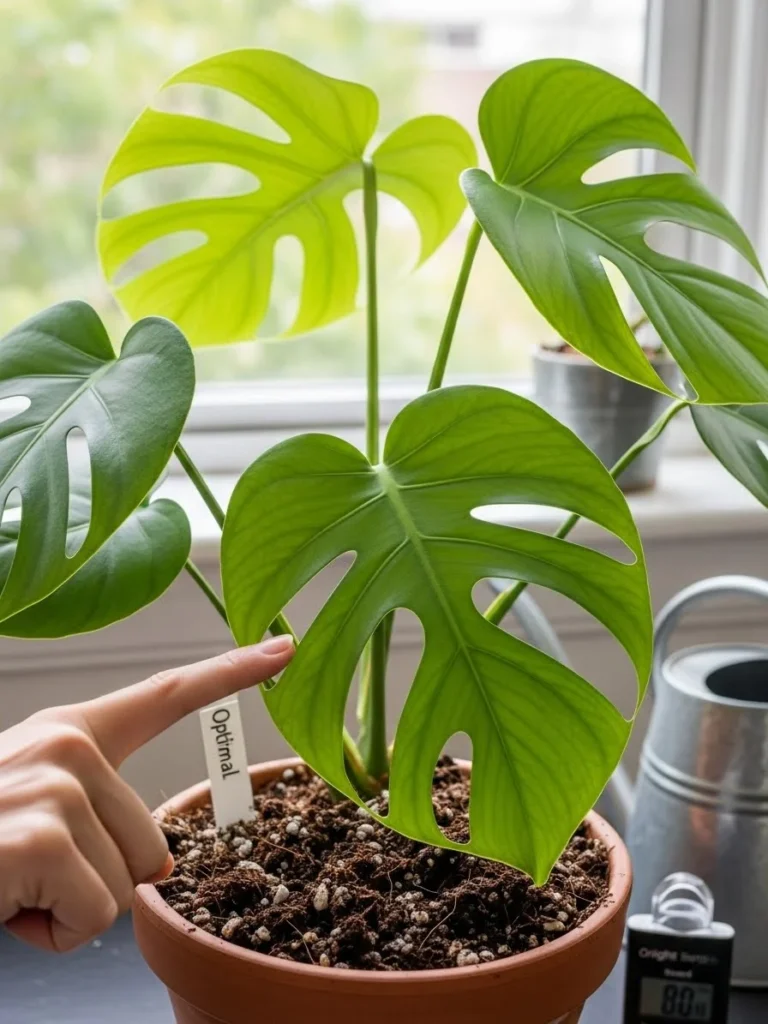
Fenestration 101: The Science Behind Split Leaves
Those iconic splits and holes in Monstera leaves aren’t just aesthetic—they’re evolutionary genius. This phenomenon, called fenestration, serves multiple purposes in nature.
Understanding Ontogeny
Monstera leaves only split when the plant reaches sufficient maturity. In botanical terms, this is called ontogeny—the developmental process from juvenile to adult form. Young Monsteras produce solid, heart-shaped leaves. As they mature and climb upward (their natural behavior), they signal readiness for fenestration.
The Wind Theory: Fenestrations allow wind to pass through large leaves without tearing them. They also permit sunlight to reach lower leaves, maximizing the plant’s overall photosynthesis.
The Moss Pole Secret
If your Monstera produces leaf after leaf without splits despite adequate light, it needs vertical support. A moss pole mimics the tree trunk your plant would climb in nature. This vertical growth signals the plant to transition into its mature form, triggering fenestration.
Implementation: Install a moss pole when your plant reaches 2-3 feet tall. Secure the main stem with soft plant ties, and keep the pole moist to encourage aerial root attachment.
Monstera Deliciosa vs. Borsigiana: Know What You Own
Many plant parents don’t realize there are two main types sold as “Monstera”:
Monstera Deliciosa:
- Distinctive ruffles at the stem connection (geniculum)
- Larger, more dramatic leaf size at maturity
- Slower growth rate
- Can reach 10+ feet indoors
Monstera Borsigiana:
- Smooth stem attachment
- Faster growth, more compact
- Smaller mature leaf size
- Better suited for limited spaces
Knowing your variety helps set realistic expectations for growth rate and ultimate size.
Creating Your Plant Microclimate
Here’s a concept most monstera care guides overlook: your room isn’t one uniform environment. You can create a localized microclimate that dramatically improves growing conditions.
The Strategy: Group your Monstera with other tropical plants. As each plant transpires (releases moisture), it increases humidity for its neighbors. This natural humidity boost is more effective than misting, which only raises moisture levels temporarily.
Bonus: Place plants on pebble trays filled with water (ensure pots don’t sit in water). As water evaporates, it creates a consistent humidity zone.
Troubleshooting Matrix: Quick Solutions
| Symptom | Probable Cause | The Fix |
|---|---|---|
| Yellowing Lower Leaves | Overwatering / Root Rot | Inspect roots for mushiness; reduce watering frequency |
| Brown Crispy Edges | Low Humidity | Add humidifier; misting is ineffective long-term |
| Leggy / Long Stems | Low Light (Etiolation) | Move closer to window or supplement with grow light |
| No Splits (Fenestration) | Lack of Support / Light | Install moss pole and increase light exposure |
| Drooping Leaves | Severe Underwatering | Water thoroughly; maintain consistent schedule |
| Black Spots on Leaves | Fungal Infection | Improve air circulation; reduce watering |
Real Talk: Learning from Failure
I once killed three Monstera leaves to root rot before understanding the signs. Here’s what it taught me: when leaves yellow suddenly and the soil smells sour, you’re already weeks into root rot. The roots turn black and mushy, and removing affected sections is your only option.
Prevention: Use terracotta pots for beginners—they wick moisture and forgive overwatering. Once you master watering, upgrade to decorative ceramic with drainage holes.
Your Action Plan
Ready to unlock your first fenestration? Here’s your 30-day roadmap:
Week 1-2: Assess current conditions. Measure light with a lux meter app, check soil composition, evaluate humidity levels.
Week 3: Repot if needed using the chunky soil recipe. Install a moss pole for plants 2+ feet tall.
Week 4: Establish your watering routine using the chopstick method. Begin tracking new growth in a journal.
Ongoing: Rotate your plant 90 degrees weekly for even growth. Wipe leaves monthly to maximize photosynthesis.
Take the next step: Download my free ‘Monstera Growth Tracker PDF’ to log your watering schedule, new leaf unfurls, and fenestration progress. Watching your plant’s transformation is incredibly rewarding when you have the data to prove it.
Remember, successful monstera care isn’t about perfection—it’s about understanding your plant’s signals and adjusting accordingly. With the right light, chunky soil, and proper watering technique, your indoor plant monstera will reward you with those magnificent split leaves that make this species a timeless favorite.
What do you think of blogging? Did it benefit you?
There are no reviews yet. Be the first one to write one.
[…] Monstera Care Guide 2025: The Science of Healthy Indoor Growth & Massive Fenestrations […]